[Nagano University Press Release] New Statistical Method Shows That Extinction Risk Can Be Estimated Reliably Even with Limited Data - Published in Methods in Ecology and Evolution and Applied to Japanese Eel
On April 17, 2026, a research paper from the Institute of Freshwater Biology, Nagano University, was published in the international journal Methods in Ecology and Evolution, published by the British Ecological Society. The study develops a new statistical framework for estimating extinction risk with accurate confidence intervals, even when only limited time-series data are available.
The study further proposes an observation-error-and-autocovariance-robust (OEAR) extension based on long-run variance estimation for cases with additive observation error and short-run dependence, and applies the framework to two national harvest-index series of Japanese eel (Anguilla japonica) covering 1957 to 2020.
The core w-z method developed in the study is implemented in the R package extr, available on CRAN.
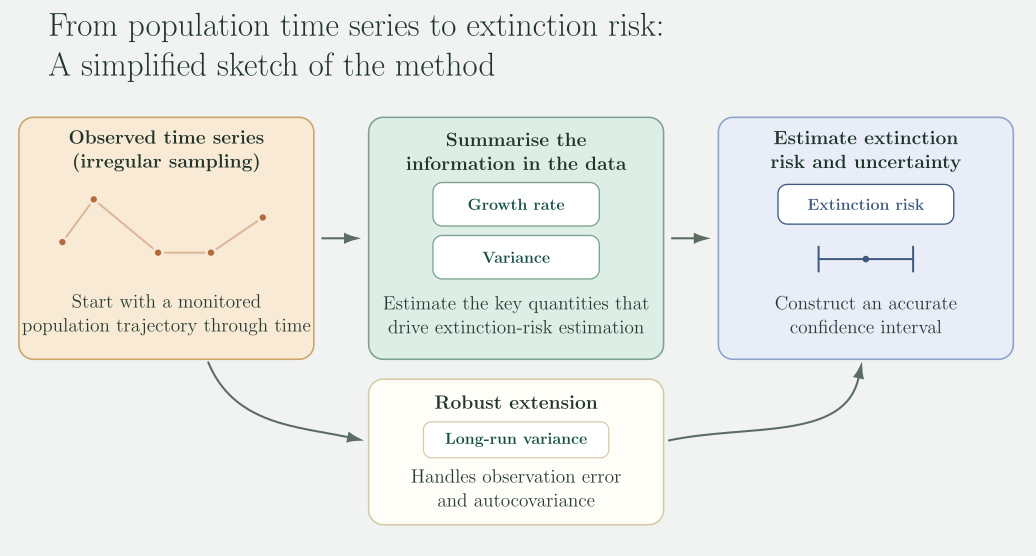
Figure. A simplified conceptual workflow of the method developed in this study, from observed time-series data to extinction-risk estimation with accurate confidence intervals, including the robust extension based on long-run variance.
Highlights of the Study
Developed a new analytical method for constructing confidence intervals for extinction probability under the drift-Wiener process, a standard model in population viability analysis (PVA).
Showed that meaningful extinction-risk estimates can still be obtained from limited data, especially when the true extinction risk is clearly low or clearly high.
Proposed a more robust OEAR estimator, based on long-run variance estimation, for data with additive observation error and short-run dependence.
Applied the method to Japanese eel and found that extinction probabilities under IUCN Criterion E remain far below the threatened-category thresholds even when confidence intervals are taken into account. Japanese eel is nevertheless currently listed as Endangered under Criterion A. The study also shows theoretically that, under the drift-Wiener model, the decline subcriteria of Criterion A systematically overestimate the extinction risk quantified by Criterion E for sufficiently large populations.
Background
The quantitative assessment of extinction risk is central to modern conservation practice, including evaluations by the IUCN Red List and CITES. However, for many years researchers have debated how reliably extinction probabilities can be estimated from short or noisy ecological time series. A widely cited concern is that, when data are limited, confidence intervals may span almost the entire 0-1 range, making the estimate practically uninformative.
At the same time, conservation practice still requires quantitative evidence. Population viability analysis (PVA) remains one of the most transparent ways to assess future extinction risk, but its usefulness depends on whether uncertainty can be evaluated in a statistically reliable way.
Purpose of the Study
This study aimed to clarify under what conditions extinction-risk estimation remains informative even under realistic data limitations, and to derive confidence intervals with accurate statistical coverage. A second goal was to extend the method to settings in which observation error and short-run temporal dependence are present.
Methods
The study focused on the drift-Wiener process, a canonical stochastic model of extinction dynamics. Instead of estimating extinction risk directly in the original model parameters, the paper introduces two transformed parameters, w and z, and carries out inference in this transformed space. Their maximum-likelihood estimators follow noncentral t distributions, making it possible to construct accurate confidence intervals for extinction probability.
The properties of the method were studied analytically and evaluated by Monte Carlo simulation. The study also introduced an OEAR extension based on HAC long-run variance estimation with AR(1) pre-whitening and a Bartlett kernel, improving robustness to additive observation error and short-run dependence while ensuring that the variance estimate remains nonnegative in finite samples.
The framework was then applied to two national Japanese eel harvest series from 1957 to 2020: a common glass-eel seed index (coastal plus inland) and an inland yellow-and-silver-eel harvest index.
Main Findings
The study shows that the width of the confidence interval for extinction probability depends not only on the amount of data, but also on effect size: how far the true extinction probability lies from the point of maximum uncertainty. This means that extinction risk can, in some cases, be estimated much more precisely than previously assumed, even from limited monitoring data.
The new confidence-interval method achieved accurate nominal coverage in simulation experiments, whereas several commonly used alternatives showed larger deviations from the nominal level. In settings with additive observation error and short-run dependence, the OEAR extension also showed stable performance and, at least within the range examined in this study, did not alter the practical threshold-based interpretation.
Japanese eel is currently listed as Endangered under IUCN Criterion A, which is based on population decline. By contrast, the extinction probabilities estimated here under IUCN Criterion E were far below the threatened-category thresholds at the relevant evaluation horizons, and the upper bounds of the confidence intervals also remained below those thresholds. This conclusion did not change across the two adopted national time series, under either the naive or OEAR approach, or under sensitivity analyses for effort-trend correction and abundance-scale calibration.
The study also shows that, under the drift-Wiener model, for sufficiently large populations, the decline subcriteria of Criterion A systematically overestimate the finite-horizon extinction risk quantified by Criterion E. This theoretical result explains the discrepancy seen above between Criterion A and Criterion E in the Japanese eel case.
Because IUCN listing can be triggered when any one of several criteria is met, such systematic overestimation creates a risk of false-positive threat classification: species that are not in fact threatened may nevertheless be ranked as threatened. As a result, conservation effort may not be directed sufficiently toward taxa facing higher extinction risk. This issue is not limited to Japanese eel, but applies broadly to marine organisms with large population sizes.
Significance and Future Outlook
The study provides an exact confidence-interval theory under the drift-Wiener process while, through the OEAR extension, offering a general framework that treats a wide class of stochastic processes with observation error and short-run dependence through an effective-diffusion approximation. A major contribution of the study is that it integrates mathematical population-dynamics models with the statistical theory of confidence intervals to provide an extinction-risk framework that can be used directly in conservation assessment.
The framework developed here should be useful for future applications of IUCN Criterion E, for methodological work on uncertainty in conservation decision-making, and for reassessing the relationships among different Red List criteria. Future work may extend the approach to broader classes of stochastic population models and to additional species of conservation concern.
Acknowledgments
This research was funded by a grant from the Japan Fisheries Agency.
Article Information
- Title: Confidence Intervals for Extinction Risk: Validating Population Viability Analysis with Limited Data
- Journal: Methods in Ecology and Evolution
- Journal Metrics: CiteScore 13.3, Journal Impact Factor 6.2, Acceptance Rate 25%
- Author: Hiroshi Hakoyama
- Status: Published on April 17, 2026
- Article DOI: https://doi.org/10.1111/2041-210X.70294
- arXiv Preprint DOI: https://arxiv.org/pdf/2509.09965
- R Package DOI: https://doi.org/10.32614/CRAN.package.extr
Contact
Institute of Freshwater Biology, Nagano University
Email: ifb@nagano.ac.jp
TEL: +81-268-22-0594
FAX: +81-268-22-0544
Contact: Hiroshi Hakoyama