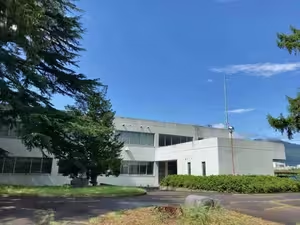
The Institute of Freshwater Biology, Nagano University is located near the Chikuma River in Ueda City, Nagano prefecture. The University of Nagano officially acquired the 24,000-square-meter facility in July 2021 from the Ministry of Finance Japan. The purpose of the institute is to conduct education, research, and industry-academia-government collaborative research projects in the interdisciplinary fields of ecology, genetics, statistics, and mathematics on the natural and biological resources of the region. The Institute of Freshwater Biology has excellent research facilities: two research buildings, 73 outdoor ponds for experiments using water from the Chikuma River, a waterfront environment with rich natural waterways, indoor experimental breeding facilities (51 FRP tanks) using well water, and a large-scale wet laboratory. The facility is also equipped with advanced research equipment such as a next-generation sequencer (NextSeq 550). The Institute of Freshwater Biology makes full use of its facilities and equipment to undertake three main activities: (1) research on the nature of the Chikuma River basin, (2) the creation of an international and national research and education network, and (3) the promotion of advanced biological research and aquaculture techniques. The organization is led by a director (professor) and consists of 9 other staff members: one associate professor, one visiting associate professor, three research assistants, one administrative and technical assistant, one office manager, one officer, and one clerk.
Institute Members
Hiroshi Hakoyama
Institute Members
At present, the organization consists of a total of 12 staff members:
The Institute of Freshwater Biology makes full use of its facilities and equipment to undertake three main activities: (1) research on the nature of the Chikuma River basin, (2) the creation of an international and national research and education network, and (3) the promotion of advanced biological research and aquaculture techniques. At present, the following, mainly externally funded, activities are being carried out:
Research on river ecology for the restoration of Chikuma River.
Researchers at the Institute of Freshwater Biology and river administrators will conduct joint research in the Chikuma River basin using an interdisciplinary approach that combines ecology, information science, and river engineering, and will contribute to the advancement and rationalization of river maintenance and management and the improvement of the river environment (funded by the Ministry of Land, Infrastructure, Transport and Tourism, River Erosion Control Technology Research and Development Area).
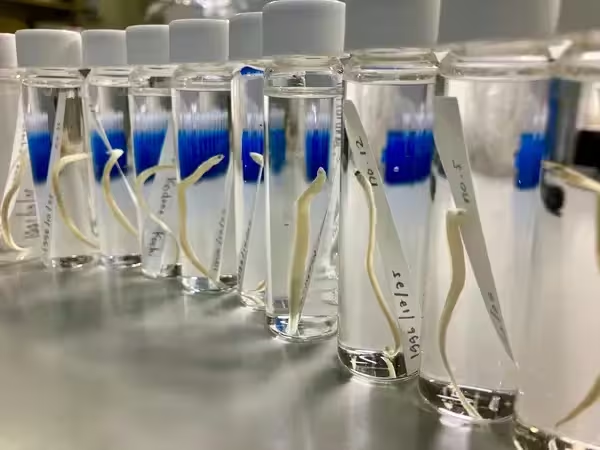
Research on the management of the Japanese eel population (Japanese Eel Unit).
Researchers at the Institute of Freshwater Biology and the Fisheries Agency are undertaking the development and analysis of management methods for understanding trends in eel resources, extinction risk, and pond management using data from catches, population genetics, and satellite tag migration surveys, with a mathematical model at the center of the framework (funded by the Fisheries Agency)
Research on Animal Personality.
Like humans, animals have different personalities due to differences in genetics and environment. In addition, correlations between traits are observed, such as bold individuals being aggressive, and these are called behavioral syndromes. By rigorously controlling for genetics and environment, and by performing precise statistical analyses using mixed-effects models, we seek to elucidate patterns of animal personality from an adaptive perspective.
Research on population dynamics of Japanese crucian carp (Carassius auratus).
The evolution of sex is a big question in biology. Using the laboratory’s ponds and experimental facilities, we will study the population dynamics and genetic exchange mechanisms of crucian carp, which include both asexual and sexual forms in their populations, to gain insight into the maintenance of sex and to understand the mechanisms by which crucian carp coexist.
External competitive research funds
Hiroshi Hakoyama
External Competitive Research Funds
From 2019 to 2026, the Institute of Freshwater Biology has acquired a total of approximately 772 million yen in external competitive research funds. Of this amount, 539.01 million yen was allocated to Nagano University, including 451.78 million yen in direct research expenses and 87.23 million yen in indirect expenses and general administrative expenses.
Ministry of Land, Infrastructure, Transport and Tourism (10,000 JPY)
Total (10,000 JPY)
2019
14,707
2,892
17,599
2020
5,913
2,314
8,227
2021
5,963
2,314
500
8,777
2022
4,641
2,314
1,487
8,442
2023
4,780
2,314
1,487
8,581
2024
4,328
2,314
1,487
8,129
2025
5,228
1,851
1,487
8,566
2026
5,500
1,900
1,487
8,887
Total
51,060
18,213
7,935
77,208
Nagano University Allocation
Fiscal Year
Fisheries Agency Commission Fee (10,000 JPY)
Fisheries Agency Subsidy (10,000 JPY)
Ministry of Land, Infrastructure, Transport and Tourism (10,000 JPY)
Total (10,000 JPY)
2019
10,023
1,617
11,640
2020
2,806
1,529
4,335
2021
3,839
1,529
142
5,510
2022
3,565
1,565
930
6,060
2023
3,622
1,668
1,144
6,434
2024
3,275
1,841
1,144
6,260
2025
4,086
1,521
1,144
6,751
2026
4,304
1,563
1,044
6,911
Total
35,520
12,833
5,548
53,901
Of the 539.01 million yen allocated to Nagano University from 2019 to 2026, 87.23 million yen consisted of indirect expenses and general administrative expenses.
From fiscal year 2019 to fiscal year 2025, the amount of external competitive funding obtained by the Institute of Freshwater Biology was approximately 74% of the total amount of external competitive funding obtained by Nagano University as a whole (average amount allocated to Nagano University for 2019-2024), and the total amount of research funding was approximately 39% of the operating subsidy of Nagano University from the local government where the institute is located (average amount of research funding for 2019-2023). All researchers and research support staff at the Institute of Freshwater Biology are employed with external competitive funding. General administrative expenses cover approximately 90% of the institute’s utility costs, and indirect expenses are used to cover the employment costs of contract staff at the Shimonogo campus.
History
Hiroshi Hakoyama
History
2018
December 6th: Mayor Yoichi Tsuchiya meets with Nagano University (University Document 1)
December 10th: Mayor Yoichi Tsuchiya meets with Nagano University (University Document 2)
December 28th: The city approves a plan to use the former National Research Institute of Fisheries Science, Ueda Station at Nagano University.
2019
April: Nagano University leases the former National Research Institute of Fisheries Science, Ueda Station from the Japan Fisheries Research and Education Agency (FRA).
April: Research Institute of Chikuma River Basin Environment and Fisheries, Nagano University (tentative name) opening preparation office established.
April: The research funding “Japanese Eel Unit” from the Fisheries Agency (Japan) accepted and started. The Institute of Freshwater Biology takes the lead in starting a large-scale research project with 35 experimental and research institutes nationwide.
May: Regulations for the establishing of the Preparatory Office for the Research Institute of Chikuma River Basin Environment and Fisheries, Nagano University (tentative name) attached to Nagano University.
May: Regulations for the Management and Operation of the Preparatory Office for the Research Institute of Chikuma River Basin Environment and Fisheries, Nagano University (tentative name) attached to Nagano University
May: Regulations for the Establishment of the Preparatory Committee for the Research Institute of Chikuma River Basin Environment and Fisheries, Nagano University (tentative name) attached to Nagano University
July 25: 1st Preparatory Committee for the Opening of the Institute
July 29: Southeast Asian Fisheries Development Center (SEAFDEC) and Nagano University signed a comprehensive research and education partnership (Memorandum of Understanding, MOU).
July 28: 1st 2020 preparatory committee for the opening of the institute
August 25: 2nd 2020 preparatory committee for the opening of the institute
September 17th: The Kanto Regional Finance Bureau 266th Kanto Council on National Property consulted and recommended that the land and buildings in Otagiri, Komaki, Ueda City, Nagano Prefecture be sold at market value to the public university corporation Nagano University for use as university facilities and grounds.
April 1st: Institute of Freshwater Biology, Nagano University established
April: An assistant professor is hired through a public recruitment process (specialty: fisheries resources / ecology / population ecology / behavioral ecology)
April: Research and Development of River Erosion Control Technology and River Ecology FS Research Fund was adopted by the Ministry of Land, Infrastructure, Transport and Tourism (Chikuma River Research Group was organized).
July 30: Nagano University acquires the former National Research Institute of Fisheries Science, Ueda station, a national property, from the Kanto Regional Finance Bureau for 95 million yen. The purchase agreement is on the condition that the property will be used only for the designated purpose of “education and research on freshwater biology and ecology” for the next 10 years as stated in the Utilization Plan in the purchase agreement between Nagano University and the government.
November 15: Opening ceremony
2022
April: Selected for the Ministry of Land, Infrastructure, Transport and Tourism’s River Erosion Control Technology Research and Development/River Ecology General Research. The Chikuma River Research Group begins a five-year project research
April: First IFB Seminar
October: Nagano University general education course Ecology begins
May: First Institute of Freshwater Biology Steering Committee (held monthly thereafter)
2024
July 18: Comprehensive collaboration on research and education between the Southeast Asian Fisheries Development Center (SEAFDEC) and Nagano University (MOU updated) was updated
September: 10th IFB Seminar, Professor Noritaka Mochioka
October: Nagano University Liberal Arts Course, “Ecology”
October: Nagano University Liberal Arts Course, “Special Lecture on Biological Environment”
November: 11th IFB Seminar, Dr. David O. Alila
January: SEAFDEC eel team visits IFB
February–March: 1st IFB Council Meeting and 2nd IFB Council Meeting
2026
April: Nagano University Liberal Arts Course, “Ecology”
June: 3rd IFB Council Meeting
History of the facility before Nagano University acquired it
1897
The Ministry of Agriculture and Commerce established the Fisheries Training Center at 2 Mita Shikoku-cho, Shiba-ku, Tokyo (the former site of the Fisheries Training Center).
1920
The Ministry of Agriculture and Forestry establishes the Kizaki Fish Farming Experimental Station of the Fisheries Training School on the shores of Lake Kizaki in Taira Village, Kitaazumi County, Nagano Prefecture (now Omachi City), and begins aquaculture experiments on trout.
1929
April: The Ministry of Agriculture and Forestry separates the testing and research departments of the Fisheries Training School and establishes the Ministry of Agriculture and Forestry Fisheries Experimental Station in Etchujima, Fukagawa Ward, Tokyo City. The Kizaki Fish Farming Experimental Station is abolished and becomes the Kizaki Branch of the Ministry of Agriculture and Forestry Fisheries Experimental Station.
1939
May: With the donation of land from Ueda City and a test pond and other structures and buildings from Nagano Prefecture, the Ministry of Agriculture and Forestry decides to establish a base for conducting aquaculture experiments using midstream rivers in Komaki Land Registry, Ueda City.
September: Construction begins. The Ueda Experimental Station of the Ministry of Agriculture and Forestry Fisheries Experimental Station is established.
14: The Kizaki Branch is abolished.
1940
March: Two government buildings and one warehouse relocated from the former Kizaki Branch, and one greenhouse relocated from the former Toyohashi Branch are completed.
1941
April: The required construction is mostly completed, and Nagano Prefecture and Ueda City submit a donation application. Seeds and seedlings are transplanted from the Motokizaki Branch and the former Toyohashi Branch, and testing operations begin.
November: The Ueda Test Site is renamed the Ueda Branch.
1942
May: The opening ceremony for the Ueda Branch is held.
1948
September: The 1948 Annual Meeting of the Japanese Society of Fisheries Science is held, with 101 participants.
1949
Due to changes in the national testing and research system, the Ministry of Agriculture and Forestry Fisheries Research Station is closed, and the Fisheries Agency’s Sea Area Fisheries Research Institutes are established in eight locations nationwide. As part of this, the Tokai District Fisheries Research Institute and the Freshwater District Fisheries Research Institute were established at Tsukishima 3, Chuo Ward, Tokyo (currently Kachidoki 5-5-1, Chuo Ward, the former site of the main Fisheries Research Institute). The Ueda Branch of the Ministry of Agriculture and Forestry Fisheries Research Institute became the Freshwater District Fisheries Research Institute Ueda Branch, with two laboratories and a general affairs section.
1953
The Freshwater District Fisheries Research Institute moved to 399 Miya, Hino-cho, Minamitama-gun, Tokyo (currently 399 Miya, Hino City).
1956
May: Memorandum of agreement on water intake from the Chikuma River (A: Freshwater District Fisheries Research Institute, B: Ueda City, Rokkamura Weir Land Improvement District).
1957
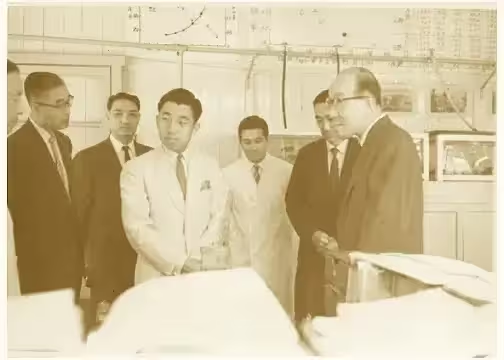
The Crown Prince Akihito visits the institute.
1963
The Crown Prince Akihito visits the institute.
1971
Construction of new office building (later joint laboratory, current administration building) begins.
1972
Completion of new office building.
1973
Start of “Comprehensive research on environmental conservation technology in agriculture, forestry and fisheries” (until 1977).
1978
Completion of accommodation.
1979
Freshwater Fisheries Research Institute is abolished, and the Fisheries Agency Aquaculture Research Institute is established at 224-1 Hiruta, Tamaki-cho, Watarai-gun, Mie Prefecture.
The Freshwater Fisheries Research Institute Ueda Station became the Tokai Fisheries Research Institute Ueda Station, and two inland water department laboratories and a general affairs annex were established. One inland water department laboratory was established in the Tokai Fisheries Research Institute Kachidoki Building.
1981
Research on pollution prevention, “Research on environmental conservation evaluation of organic sludge and its use in agriculture and forestry” started (up till 1985).
1989
With the Fisheries Agency Tokai Fisheries Research Institute becoming the National Research Institute of Fisheries Science, the Ueda Station became the National Research Institute of Fisheries Science Ueda Station, and two inland water utilization department laboratories and a general affairs annex were established. One inland water utilization department laboratories was established in the Central Fisheries Research Institute Kachidoki Building.
1990
Construction of a new research and experiment building started.
1992
Same as above completed.
1993
February: Opening ceremony for the same as above held. The research pond refurbished.
1994
June: The refurbishment of the exterior and interior walls of the building.
1995
July: Key Basics “Elucidation of interactions between individuals due to semiochemical substances in sweetfish spawning” (single year).
Internet connection.
1996
July: Ueda Station opened to the public.
1998
August: Sweetfish Cold Water Disease Prevention Study Group launched.
2001
April: Fisheries Agency research institutes merged with Fisheries Research Agency and restarted.
2002
April: Fisheries Agency survey on the impact of bluegill predation, etc. (2002-2006).
2004
April: National Research Institute of Fisheries Science, Inland Water Utilization Department renamed to Inland Water Research Department.
2005
April: Ministry of Education, Culture, Sports, Science and Technology, Design of habitats in biological conservation - Focusing on the sustainability of metapopulations. (2005-2006).
2006
April: Ministry of the Environment, Global Environmental Research Fund, Research on habitat network formation technology for native freshwater fish conservation. (2006-2008).
2007
April: Agriculture, Forestry and Fisheries Technology Council, Development of technology to prevent damage to fisheries caused by cormorants (2007-2009).
Fisheries Agency, Invasive fish control and management technology development project (2007-2011).
November: Secretariat of the Japan Society of Fisheries Science Chubu Branch Conference, 21, 2008-11-21, Cormorant Symposium, Ueda Onsen Hotel Shoen.
2011
April: The National Research Institute of Fisheries Science, Ueda Station was renamed to the National Research Institute of Aquaculture, Ueda Station due to organizational restructuring.
2013
April: Fisheries Agency, Fisheries Promotion Project with Consideration for Biodiversity. (2013-2015).
April: River Improvement Fund, River Foundation, Environmental Carrying Capacity of River Eel Habitats and Causes of Decline: Analysis from Fishing Data.
2016
April: The National Research Institute of Aquaculture, Ueda Station was renamed to the National Research Institute of Fisheries Science, Ueda station due to organizational restructuring.
December: The direction of closing the Ueda Station was decided at the Management Planning Meeting.
2019
March: Ueda Station closed.
April: Nagano University leased the Ueda Station from the Japan Fisheries Research and Education Agency and began using it.
Expenses
Hiroshi Hakoyama
Utility Expenses
Breakdown by Source of Funds
Amounts are shown in units of 10,000 JPY.
In this table, “Commissioned funds” and “Subsidy” refer to funds from the Fisheries Agency. “Operating grant” refers to the operating grant from Nagano University.
 The Institute of Freshwater Biology, Nagano University is located near the Chikuma River in Ueda City, Nagano prefecture. The University of Nagano officially acquired the 24,000-square-meter facility in July 2021 from the Ministry of Finance Japan. The purpose of the institute is to conduct education, research, and industry-academia-government collaborative research projects in the interdisciplinary fields of ecology, genetics, statistics, and mathematics on the natural and biological resources of the region. The Institute of Freshwater Biology has excellent research facilities: two research buildings, 73 outdoor ponds for experiments using water from the Chikuma River, a waterfront environment with rich natural waterways, indoor experimental breeding facilities (51 FRP tanks) using well water, and a large-scale wet laboratory. The facility is also equipped with advanced research equipment such as a next-generation sequencer (NextSeq 550). The Institute of Freshwater Biology makes full use of its facilities and equipment to undertake three main activities: (1) research on the nature of the Chikuma River basin, (2) the creation of an international and national research and education network, and (3) the promotion of advanced biological research and aquaculture techniques. The organization is led by a director (professor) and consists of 9 other staff members: one associate professor, one visiting associate professor, three research assistants, one administrative and technical assistant, one office manager, one officer, and one clerk.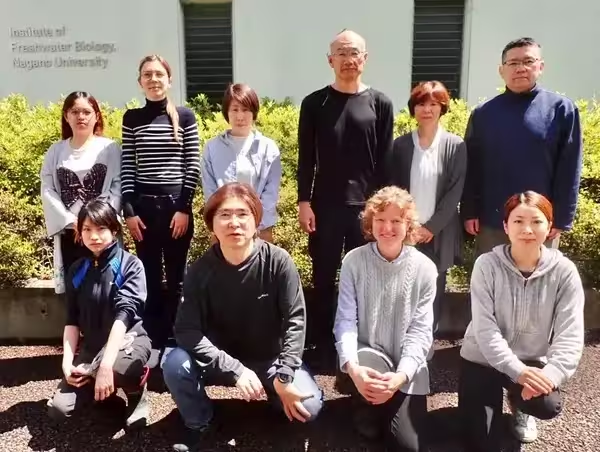
 The Institute of Freshwater Biology makes full use of its facilities and equipment to undertake three main activities: (1) research on the nature of the Chikuma River basin, (2) the creation of an international and national research and education network, and (3) the promotion of advanced biological research and aquaculture techniques. At present, the following, mainly externally funded, activities are being carried out: